#_ binary security
A running rough guide and notes into binary security. Thoughts are my own.
binsec introductive primer
* the execution of computer code is dependent on many support strcutures and systems that allow for portable and flexible applications.
* multiple standards and conventions to be aware of defined by ABI - byte storage (endianness) - calling conventions - the name(eip/rip), size(32/64bit) and number and type of CPU registers.
memory managament:
- Imagine a factory with a robot (CPU) whose only job is to execute instructions delivered on a conveyor belt. The robot does not question instructions — it simply executes whatever arrives.
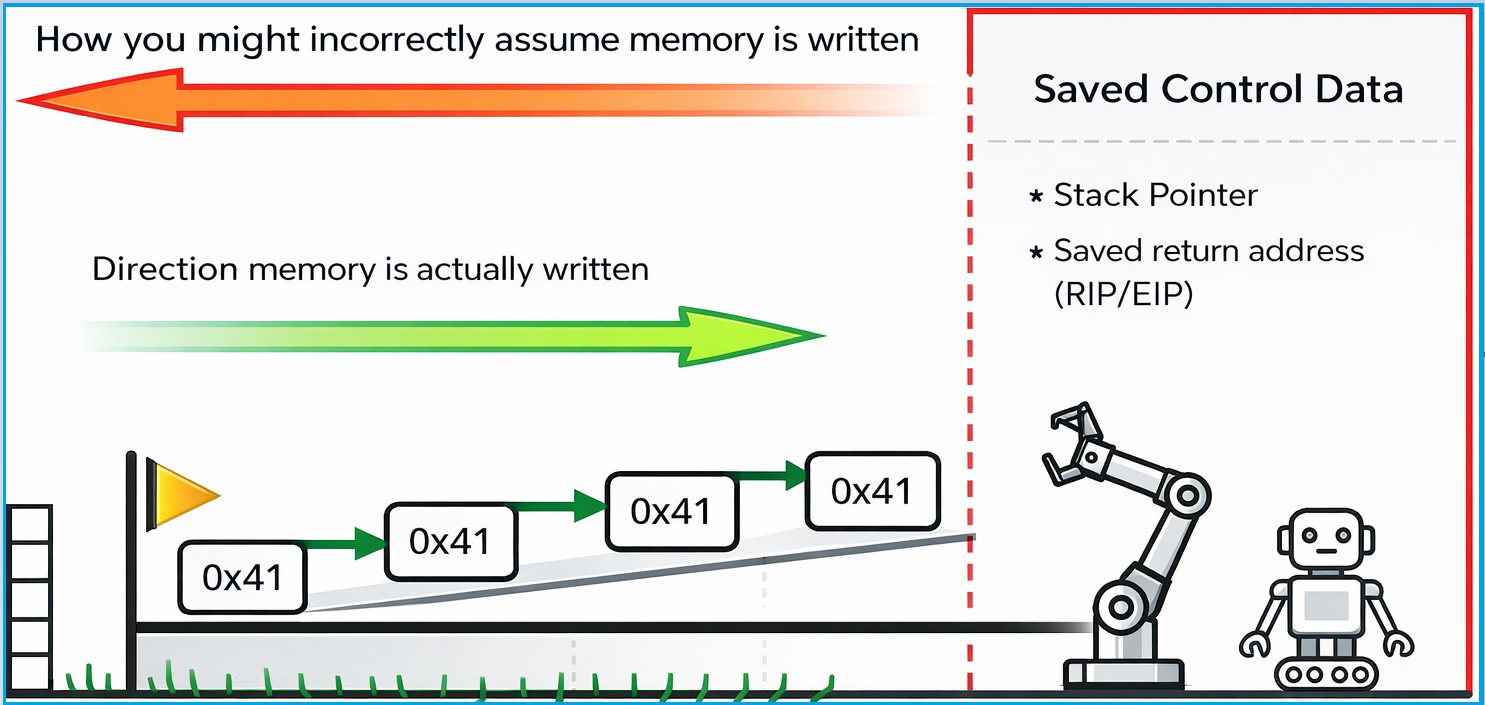
- When a program allocates a memory buffer, it is assigned a fixed-sized section of memory. The program assumes it will only write data within that space.
- If more data is written than the buffer can hold, the excess data overwrites whatever memory happens to be next.
Often sensitive control information such as saved return addresses or function pointers.
- By overflowing a buffer, an attacker can overwrite this control data. The robot (CPU) does not check for integrity. It will just execute.
If you replace the information in the control room with your own code the robot will still execute it.
- The Stack grows downward. Memory writes advance upwards.
 code execution wrapper:
- a binary file is just not code instrictions in the same layout as the programmer saw in the IDE.
- the code, data and support strcuture tables (for example resolving dynamic libraries) are sorted into Sections. {.text, .data, .plt, .got, .bss}
- the programmer can set security flags that will be read and applied by the executing Operating System. Providing needed security mitigations. {NX, PIE, DEP}
- wrapper is typically ELF (Linux) or PE/MZ (Windows).

Stack Protection x86 - Canary
Basically a Stack integrity sentinel value.
Our Layout Map | Our Actions |
| Thread Control Block (TCB linux) (TEB windows) => FS_base => TLS | |
| Thread Local Storage (TLS) | - glibc create cancary value and stores in TLS |
| Registers | - LOAD, STORE, COMPARE, BRANCH |
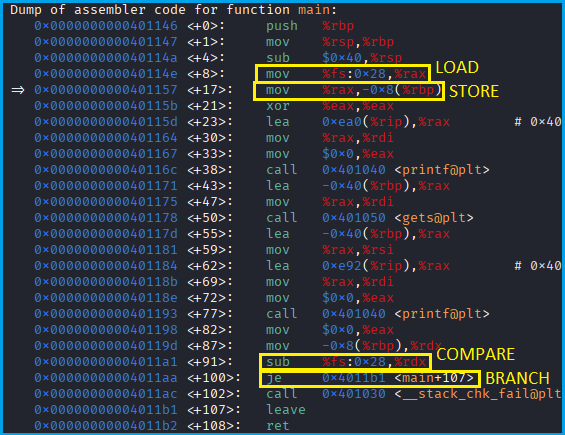 | 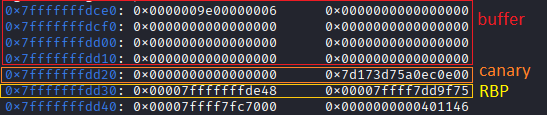 |  |  |
| Dump main() | Stack Frame | The Stack - Canary | Thread Local Storage - Canary |
Stack Protection ARM - Canary
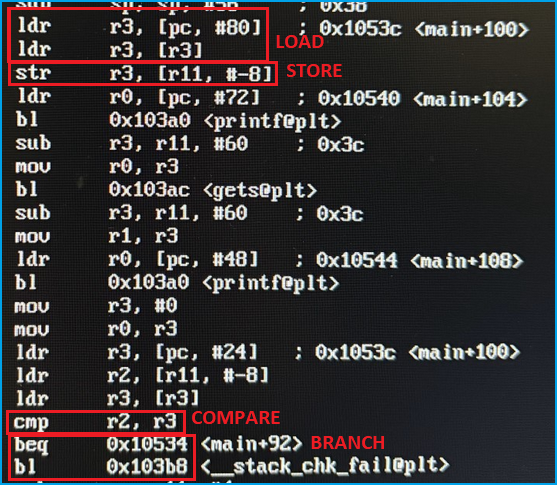
    * The ARM LOAD process:
                            At runtime a pointer to the TLS canary value is store in the ARM literal pool (think .text section)
                            Memory loads work off relative addressing. The memory expression must be resolved to be calculated.
                            For Example r3, (PC + #80). Program Counter + 80offset is resolved and mem addr is stored in r3.
                            The r3 memory addr is dereferenced and the value is stored in r3.
Know thyself address
    * JMP CALL POP:
                    Shellcode running, Awesome. However I don't know where I am. Thanks ASLR.
                    Share libraries (.dll, .so) are Position-Independent-Code and have the same problem.
                    Legit uses (RIP-Relative-addressing).
                    Shellcode, we roll our own.

                    I have shell code running within a process, but i don't know my own address or how to access other areas of memory within the process by offsets, self+10.
                    Because of ASLR, I know when the code jumps to another function or external library, which is in another memory area, it needs to know how to get back to
                    continue execution, it needs an address within the original  memory area.
                    As part of normal operation this key memory address information is placed on the Stack, basically to get it out we just need to POP this address,
                    which just before the end of the called function will be top of Stack ESP, we can POP off this address into a register.
                    Awesome we can query that register to get the 'self' address and use offsets +10 into other areas of memory within our process.

    * We would make the Call internal to our shellcode blob and not jump external.

    ```asm
    _start:
        call get_self

    data: memflag "foobarr"

    get_self:
        pop esi
    ```